AdvancedPeacefulReef SafeIUCN: Not Evaluated
Spotted Garden Eel
Heteroconger hassi
Family: Congridae · Oddball & Rare Fish
Also known as: Hass's Garden Eel, Garden Eel, Spotted Heteroconger
(c) Alexandra Hoschke, some rights reserved (CC BY-NC)
Max Size
16"
Min Tank
40 gal
Lifespan
5-10 years
Origin
Indo-Pacific, Red Sea
Diet
Planktivore
Swims
Bottom
Did You Know?
- Spotted Garden Eels never fully leave their burrows — their tails remain anchored in the sand at all times, and they secrete a mucus lining that stabilizes the burrow walls
- Wild colonies can contain thousands of individuals spread across sandy slopes, creating the appearance of an underwater garden swaying in the current
- Neighboring garden eels will fight over territory by biting each other while both remain partially submerged in their respective burrows — like an underwater version of neighbors arguing over a fence
About
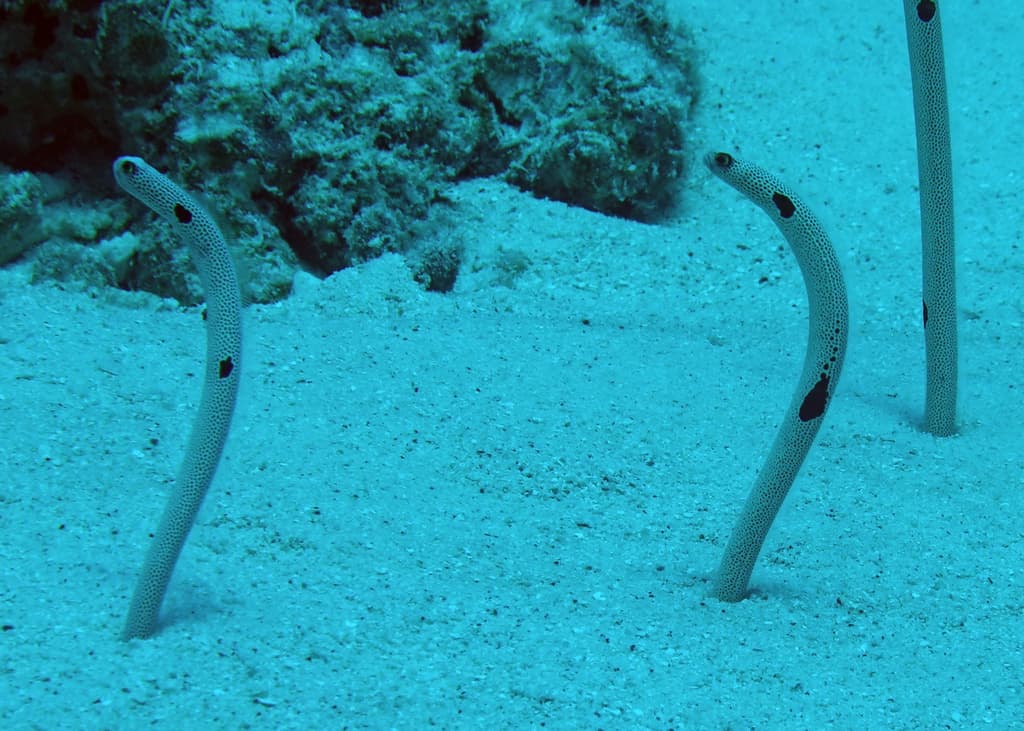
The Spotted Garden Eel is one of the most visually captivating and unusual marine animals available to aquarists, famous for its colony-dwelling behavior where dozens or hundreds of individuals extend from the sandy bottom like a field of living plants swaying in the current. Each eel is slender and elongated, reaching about 16 inches in length, with a pale body densely covered in small black spots. They live in permanent burrows excavated in sandy substrate, anchoring their tails in the sand while extending their upper bodies into the water column to pluck passing zooplankton from the current.
In the wild, Spotted Garden Eels form vast colonies on sandy slopes near coral reefs, typically in areas with gentle to moderate current that carries a continuous supply of planktonic food. The sight of hundreds of eels simultaneously emerging from the sand and swaying in unison is one of the most iconic scenes on Indo-Pacific reefs. They are extremely shy and will retract completely into their burrows at the approach of divers, predators, or any perceived disturbance, re-emerging cautiously minutes later.
Keeping Spotted Garden Eels in captivity is notoriously challenging and requires a specialized setup. A deep sand bed of at least 6 to 8 inches of fine, soft sand is essential for burrow construction. The tank should be placed in a low-traffic area, as garden eels are extremely skittish and may remain permanently buried if subjected to frequent disturbances. They feed exclusively on planktonic organisms carried by the current and must be provided with a constant or near-constant supply of live or frozen planktonic foods. A group of at least three to four individuals is recommended, as they are social animals that feel more secure in the presence of conspecifics.
Feeding & Diet
Planktivore
Spotted Garden Eels are obligate planktivores that feed on tiny zooplankton carried by water currents. In captivity, provide frequent feedings of live or frozen cyclops, copepods, baby brine shrimp, and finely chopped mysis shrimp delivered in the water current so it drifts past the eels. An automated feeding system or dosing pump delivering small amounts of food throughout the day significantly improves success. Live phytoplankton and copepod cultures can supplement the diet.
Compatibility
reef-safepeacefulspecies-tank-preferredburrowergroup-compatibleexpert-only
Spotted Garden Eels are among the most timid marine animals in the hobby and must be housed only with extremely peaceful, non-threatening tankmates. Even moderately active fish can cause garden eels to remain permanently hidden in their burrows and slowly starve. Suitable companions include small, peaceful gobies, pipefish, and seahorses. Absolutely avoid any active swimmers, aggressive feeders, or predatory species. A species-specific setup is ideal for long-term success.
Check CompatibilityBreeding
Not bred in captivity
Spotted Garden Eels have not been bred in home aquariums. In the wild, neighboring male-female pairs extend toward each other from their respective burrows to intertwine and spawn. The pelagic larvae undergo a long planktonic development phase that has not been replicated in captivity. Sexing live specimens is extremely difficult.
Special Requirements
- Deep fine sand bed of 6-8 inches essential for burrow construction
- Place tank in a low-traffic area — extremely skittish species
- Gentle to moderate water flow to deliver planktonic food past the eels
- Multiple daily feedings of planktonic foods required
- Best kept in groups of 3 or more for social security
- Avoid boisterous or aggressive tankmates that will cause permanent hiding
- Automated feeding system highly recommended
Water Parameters
Temperature72–82°F
Specific Gravity1.02–1.026 sg
pH8–8.4
Alkalinity8–12 dKH
Coloration
whitecreamblack spots
Tags
reef-safepeacefulspecies-tank-preferredburrowergroup-compatibleexpert-only