IntermediateSemi-AggressiveNot Reef Safe
Golden Grouper
Saloptia powelli
Family: Serranidae · Groupers & Basslets
Also known as: Powell's Grouper, Golden Rockcod
(c) Shakirin Keegan, all rights reserved
Max Size
12"
Min Tank
125 gal
Lifespan
12-18 years
Origin
Western Pacific, Melanesia
Diet
Carnivore
Swims
Bottom
About
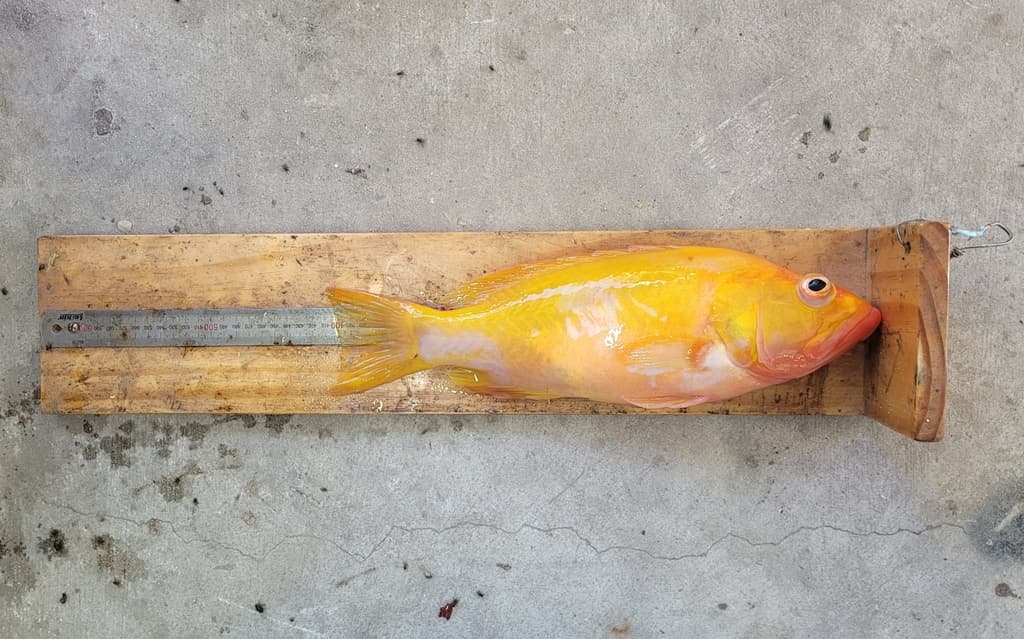
The Golden Grouper is one of the rarest and most visually stunning grouper species available in the marine aquarium trade. Its entire body is a brilliant golden-yellow color, making it an extraordinarily eye-catching centerpiece fish. This species is the sole member of the genus Saloptia, making it taxonomically unique among groupers.
In the wild, Golden Groupers are found exclusively in the Western Pacific, primarily around Melanesia including Papua New Guinea and the Solomon Islands. They inhabit coral reefs and rocky areas at moderate depths, where their golden coloration stands out among the reef structure. Due to their restricted range, they are rarely encountered and remain one of the most sought-after grouper species.
In captivity, the Golden Grouper is a prized and expensive acquisition. At a maximum size of about 12 inches, it is one of the more manageable grouper species for home aquariums, requiring a minimum tank of 125 gallons. It adapts reasonably well to captive conditions but commands a premium price due to its rarity and striking appearance.
Feeding & Diet
Carnivore
A carnivorous predator that feeds on small fish and crustaceans. Offer a varied diet of frozen silversides, krill, shrimp, squid, and high-quality carnivore pellets. Feed every other day for adults. Newly imported specimens may require live food initially before transitioning to frozen preparations.
Compatibility
predatorlarge-fish-onlyFOWLRhigh-bioload
The Golden Grouper is semi-aggressive and will prey on any fish small enough to swallow. Best housed with similarly sized or larger robust species such as tangs, large angelfish, triggerfish, and other groupers. Avoid keeping with small fish, ornamental shrimp, or delicate invertebrates. Its rarity makes it a prized centerpiece fish.
Check CompatibilityBreeding
Not bred in captivity
As the only member of its genus, the Golden Grouper's reproductive biology is poorly studied. Like most groupers, it is presumed to be a protogynous hermaphrodite. Captive breeding has not been attempted or achieved due to the species' extreme rarity.
Special Requirements
- Extremely rare and expensive species
- Requires a tank with caves and overhangs for security
- Will consume any fish or invertebrate small enough to swallow
- Newly imported specimens may need live food initially
- Provide strong filtration due to carnivorous diet
Water Parameters
Temperature72–78°F
Specific Gravity1.02–1.025 sg
pH8.1–8.4
Alkalinity8–12 dKH
Coloration
golden yellowbright gold
Tags
predatorlarge-fish-onlyFOWLRhigh-bioload