IntermediateSemi-AggressiveNot Reef Safe
Bandit Angelfish
Apolemichthys arcuatus
Family: Pomacanthidae · Large Angelfish
Also known as: Banded Angelfish, Black-banded Angelfish, Hawaiian Bandit Angelfish
(c) olieturner3, some rights reserved (CC BY-NC)
Max Size
7"
Min Tank
125 gal
Lifespan
10-15 years
Origin
Hawaii, Johnston Atoll
Diet
Omnivore
Swims
Middle
About
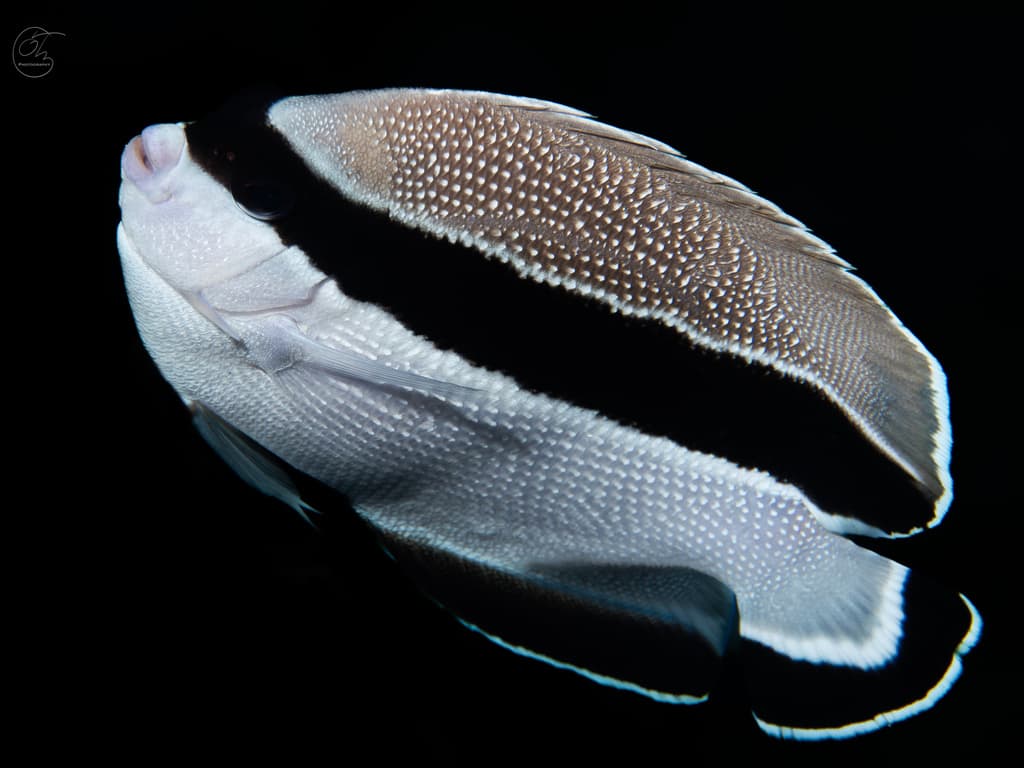
The Bandit Angelfish is a strikingly elegant Hawaiian endemic that stands apart from most angelfish with its understated yet dramatic coloration. Its pearly white to light gray body is bisected by a bold black diagonal band that runs from the dorsal fin through the eye and down to the lower jaw, giving it the bandit mask appearance that inspires its common name. The dorsal and caudal fins are edged in black, and the overall effect is a clean, graphic pattern unlike any other angelfish species.
As a Hawaiian endemic, the Bandit Angelfish is found primarily around the main Hawaiian Islands and Johnston Atoll. It inhabits deep reef slopes, caves, and ledges, typically at depths of 20 to 150 meters, though it is most commonly encountered between 40 and 80 meters. The combination of deepwater habitat and strict Hawaiian collection regulations has historically limited supply. However, captive breeding programs have successfully propagated this species, making captive-bred juveniles available to aquarists.
The Bandit Angelfish adapts reasonably well to aquarium life and is considered one of the more robust members of the Apolemichthys genus. It requires a spacious aquarium of at least 125 gallons with plenty of live rock caves and overhangs that replicate its natural deepwater habitat. While not reef safe due to its tendency to nip at sponges, tunicates, and occasionally soft corals, it makes an outstanding centerpiece in a fish-only or fish-only-with-live-rock system.
Feeding & Diet
Omnivore
Bandit Angelfish are omnivores with a strong preference for sponges and tunicates in the wild. In captivity, offer sponge-based angelfish preparations, frozen mysis shrimp, enriched brine shrimp, spirulina sheets, and high-quality pellet foods. A varied diet including both meaty and algae-based foods is essential for long-term health.
Compatibility
not-reef-safesemi-aggressivecommunity-compatiblelarge-angelfish-territorialsponge-eater
The Bandit Angelfish is semi-aggressive and may be territorial toward other large angelfish. It coexists well with tangs, larger wrasses, and other robust community fish. Avoid housing with overly aggressive species or other Apolemichthys angelfish.
Check CompatibilityBreeding
Difficult
The Bandit Angelfish has been successfully captive bred, notably by facilities specializing in Hawaiian marine species. It is a pelagic spawner that forms pairs or small harems. Captive-bred specimens are hardier and adapt to aquarium foods more readily than wild-caught individuals.
Special Requirements
- Hawaiian endemic — captive-bred specimens increasingly available
- Provide caves, ledges, and overhangs to replicate deepwater habitat
- Not reef safe — will nip at sponges, tunicates, and potentially soft corals
- Minimum 125 gallon aquarium with abundant live rock structure
- Best kept as the only large angelfish in the system
- Varied diet with sponge-based foods important for long-term health
Water Parameters
Temperature72–78°F
Specific Gravity1.02–1.026 sg
pH8.1–8.4
Alkalinity8–12 dKH
Coloration
whitegrayblack
Tags
not-reef-safesemi-aggressivecommunity-compatiblelarge-angelfish-territorialsponge-eater