ExpertSemi-AggressiveReef Safe
Spotted Sweetlips
Plectorhinchus picus
Family: Haemulidae · Grunts & Sweetlips
Also known as: Painted Sweetlips, Dotted Sweetlips, Trout Sweetlips
(c) Ian Shaw, all rights reserved
Max Size
35"
Min Tank
400 gal
Lifespan
12-25 years
Origin
Indo-Pacific, Western Pacific
Diet
Carnivore
Swims
Middle
About
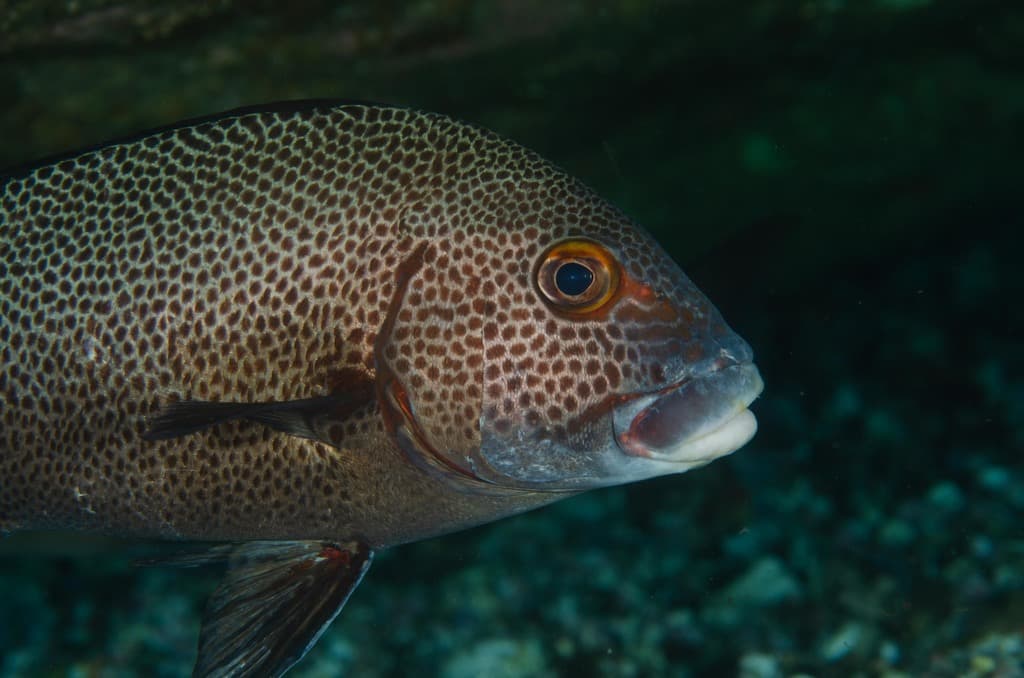
The Spotted Sweetlips is one of the largest members of the Plectorhinchus genus, capable of reaching an impressive 35 inches in length in the wild. Adults are easily identified by their creamy white to pale grey body densely covered with large, round dark brown to black spots, creating a dramatic polka-dot appearance. The thick, fleshy lips characteristic of sweetlips are particularly prominent in this species. Juveniles display the typical sweetlips transformation pattern, starting with a dark body featuring bold white patches before gradually developing the spotted adult coloration over several years.
In the wild, Plectorhinchus picus is distributed across the Indo-Pacific, from Indonesia and the Philippines to the Great Barrier Reef and Fiji. Adults are found on coral reef slopes and outer reef walls at depths of 3 to 50 meters, often in small groups sheltering under large table corals, in caves, or beneath overhangs. They are primarily nocturnal predators, feeding on crustaceans, worms, echinoderms, and small fish during their nighttime foraging expeditions across the reef.
The Spotted Sweetlips is among the most challenging marine fish to maintain in captivity. Its enormous adult size demands an aquarium of at least 400 gallons, and like other large sweetlips, it is extremely difficult to wean onto prepared foods. Most imported specimens are juveniles that stubbornly refuse to eat anything other than live foods, and the mortality rate during acclimation is very high. This species is recommended only for the most experienced and dedicated expert aquarists with exceptionally large, mature systems.
Feeding & Diet
Carnivore
Spotted Sweetlips are carnivores that feed on crustaceans, worms, echinoderms, and small fish in the wild. In captivity, weaning is exceptionally difficult. Start with live ghost shrimp, live blackworms, and live feeder shrimp. Attempt gradual transition to frozen mysis, whole silversides, krill, and chopped clam or squid over an extended period. Many specimens never fully transition away from live foods.
Compatibility
semi-aggressiveFOWLRvery-large-tankexpert-onlypredator
The Spotted Sweetlips can be semi-aggressive, particularly toward smaller fish that may be viewed as prey given its large adult size. Best housed with other very large, robust species such as groupers, large angels, and tangs. Despite being reef-safe regarding corals, it will consume any crustaceans, worms, and small fish it can fit in its mouth. A large FOWLR system is most appropriate.
Check CompatibilityBreeding
Not bred in captivity
Spotted Sweetlips have not been bred in home aquariums. As pelagic spawners, they release eggs into open water in the wild. The extreme difficulty of maintaining this species in captivity, combined with its enormous adult size, makes captive breeding effectively impossible with current hobbyist capabilities. All specimens are wild-caught.
Special Requirements
- Extremely large adult size requires a minimum 400-gallon aquarium
- Nearly impossible to wean onto prepared foods — live food often needed long-term
- Very high mortality rate during acclimation — quarantine essential
- Pristine water quality non-negotiable — highly sensitive to dissolved wastes
- Only for expert aquarists with very large, well-established systems
Water Parameters
Temperature72–80°F
Specific Gravity1.02–1.026 sg
pH8.1–8.4
Alkalinity8–12 dKH
Coloration
whitecreamdark brown spotsblack spotsbrown (juvenile)
Tags
semi-aggressiveFOWLRvery-large-tankexpert-onlypredator