BeginnerAggressiveReef Safe
Blue Devil Damsel
Chrysiptera cyanea
Family: Pomacentridae · Damselfish
Also known as: Blue Damselfish, Sapphire Devil, Blue Demoiselle, Orangetail Blue Damselfish
(c) Shigeru Harazaki, all rights reserved
Max Size
3"
Min Tank
20 gal
Lifespan
5-8 years
Origin
Indo-Pacific, Indonesia
Diet
Omnivore
Swims
All
About
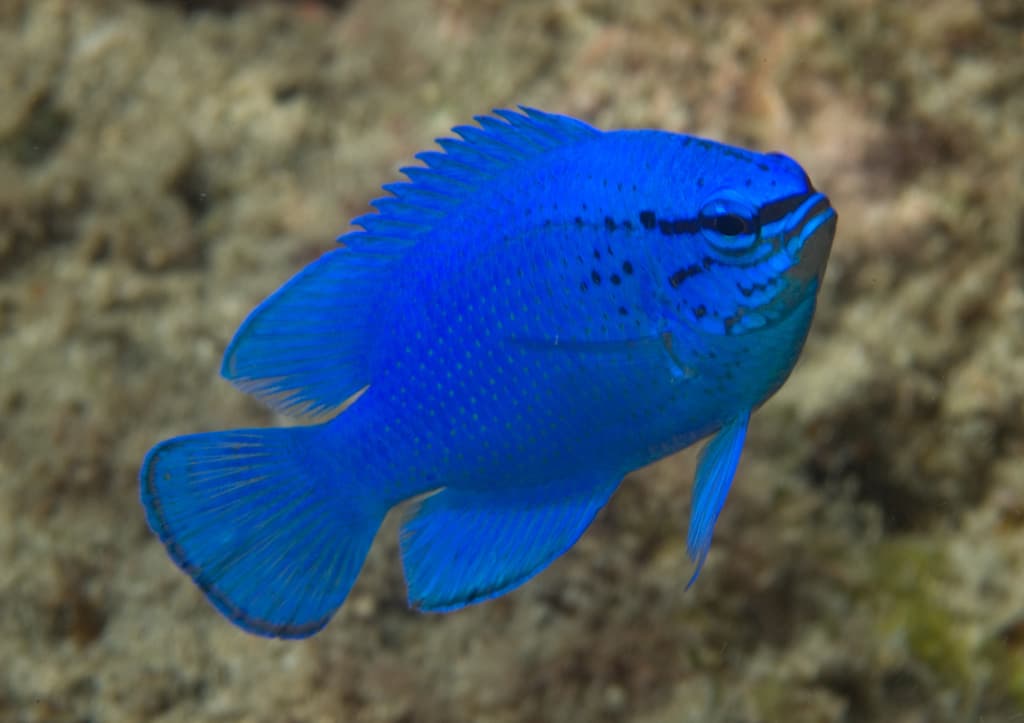
The Blue Devil Damsel is one of the most strikingly colored and widely available damselfish in the marine aquarium trade, renowned for its brilliant neon-blue coloration that makes it instantly recognizable. Males display an entirely electric blue body with a subtle orange or yellow tint at the tail, while females are often slightly duller with a clear or yellowish tail. This small but feisty fish is a member of the Chrysiptera genus, which contains some of the more manageable damselfish species, though the Blue Devil still earns its devilish name through persistent territorial behavior.
In the wild, Chrysiptera cyanea inhabits shallow coastal reefs and rubble zones throughout the Indo-Pacific, where it stakes out small territories among coral heads and rock crevices. It feeds opportunistically on algae, zooplankton, and small invertebrates, darting out from cover to snatch food before retreating to its defended territory. This territorial behavior translates directly to the aquarium, where the Blue Devil Damsel will aggressively defend its chosen area against fish of similar size and coloration.
Despite its aggressive temperament, the Blue Devil Damsel remains popular because of its extreme hardiness, brilliant color, and low price point. It is often used to cycle new aquariums, though this practice is increasingly discouraged in favor of fishless cycling methods. For best results, add this species last to a community tank to minimize territorial aggression, and provide plenty of rockwork with multiple hiding spots. A single specimen in a well-established reef aquarium can be a stunning addition, provided tankmates are chosen carefully to avoid bullying of more timid species.
Feeding & Diet
Omnivore
Blue Devil Damsels are unfussy omnivores that accept virtually any aquarium food. In the wild, they feed on filamentous algae, zooplankton, and benthic invertebrates. In captivity, offer a varied diet of marine flakes, micro-pellets, frozen mysis shrimp, enriched brine shrimp, and finely chopped seafood. Supplement with algae-based foods such as Spirulina flakes to maintain optimal coloration. Feed two to three times daily in small amounts.
Compatibility
reef-safeaggressiveterritorialhardy
The Blue Devil Damsel is highly territorial and will aggressively defend its chosen area against similarly sized or smaller fish. It is best housed with larger, more assertive species such as tangs, angelfish, and wrasses that can hold their own. Avoid housing with other small damselfish, gobies, or timid species that may be bullied relentlessly. Despite its aggression toward fish, it is completely reef-safe and will not harm corals or invertebrates.
Check CompatibilityBreeding
Moderate
Blue Devil Damsels are sexually dimorphic, with males typically displaying brighter blue coloration and an orange-tipped tail. They are substrate spawners that lay adhesive eggs on cleaned rock surfaces. The male guards the nest aggressively until the eggs hatch in approximately 3-4 days. Breeding occurs regularly in captivity, but rearing the tiny pelagic larvae requires specialized food cultures of rotifers and copepods.
Special Requirements
- Add last to community tanks to reduce territorial aggression
- Provide abundant rockwork with caves and crevices
- Best kept singly unless in a large tank with multiple hiding spots
- May harass shy or slow-moving tankmates
Water Parameters
Temperature72–82°F
Specific Gravity1.02–1.026 sg
pH8.1–8.4
Alkalinity8–12 dKH
Coloration
blueneon blueorange
Tags
reef-safeaggressiveterritorialhardy